Digital impressions: why the tray of goop went away
The mouthful of putty was the part most patients hated. Here is what replaced it and why the fit is better.
September 17, 2026 · 3 min read
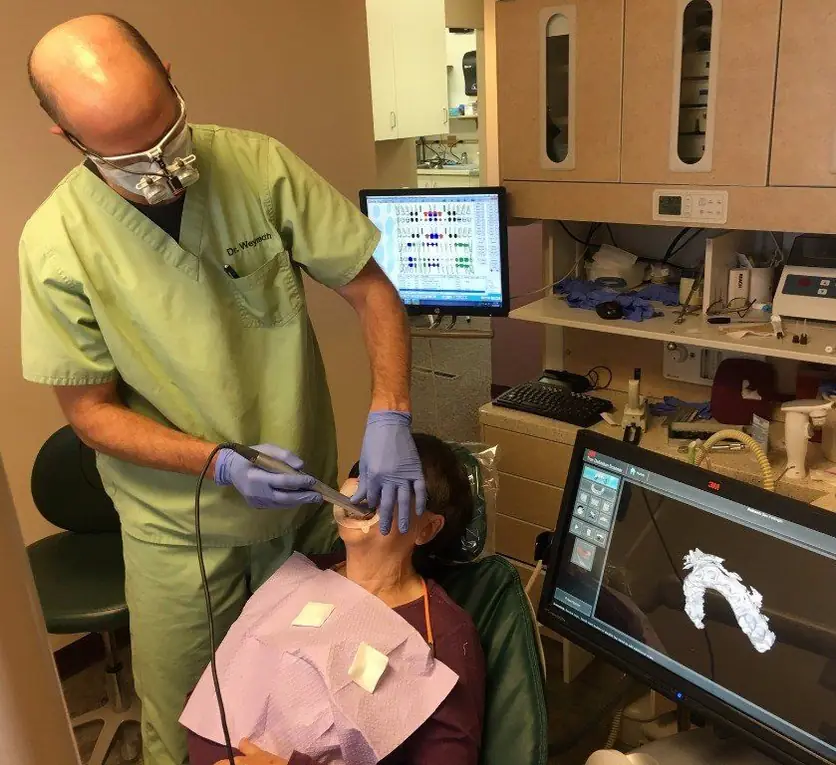
If you have had a crown or a denture made at any point in the last thirty years, you will remember the impression. A tray loaded with soft material, pushed onto your teeth, held there while it set, and a few minutes of trying not to gag. It worked. Almost nobody enjoyed it.
That step is now done with a digital impression scanner, which is a small wand with a camera on the end. It is passed over your teeth and builds a three dimensional model on the screen as it goes. Nothing sets in your mouth and there is nothing to hold still for.
What the appointment feels like now
The scanner is roughly the size of an electric toothbrush head. It moves over the biting surfaces, then the inside and outside of the arch. You can breathe and swallow normally throughout, and if you need a break the scan pauses and picks up where it stopped.
The model appears on a monitor while this happens, which is the part patients tend to comment on. You can see your own teeth rotating on screen from angles you have never seen them from. When we point at the tooth we are talking about, you are looking at the same thing we are, rather than taking a description on trust.
Why the fit tends to be better
A physical impression is a physical object, and physical objects can distort. The material can pull slightly as the tray comes out. It can shrink a little as it cures. It gets poured into a stone model, which introduces its own small error, and then it is shipped, which is another opportunity for something to go slightly out.
Every one of those steps is small on its own. Stacked together they are the reason a crown sometimes came back needing adjustment, or a partial denture needed more than one visit to sit right.
A digital scan is a file. It does not shrink, it does not distort on the way out of your mouth, and it does not change in transit. The dental laboratory works from the same data we captured. That does not make an imperfect fit impossible, but it removes several of the reasons it used to happen.
There is also an immediate check that the old method never had. If a section of the scan is incomplete, the software shows the gap while you are still in the chair. That section gets rescanned in a few seconds. Under the old system, a flawed impression was often only discovered later, and you came back in.
Where it gets used
- Crowns and other restorative work that a laboratory fabricates
- Partial dentures, where fit against remaining teeth is the whole job
- Dental implants, for planning and for the restoration on top
- Records of how your bite sits, to compare against later
For partial dentures in particular the difference matters a great deal. A partial has to sit against the teeth you still have, and small errors are what cause a denture to rock, rub or need repeated adjustment. Starting from an accurate model removes a category of problem rather than correcting it afterward.
The rest of what is in the room
The scanner is one of several things here that changed the same way. Digital x-rays produce an image on the screen straight away. Intra oral video cameras let you see a cracked filling at a size where the problem is obvious rather than described. Patient charts and insurance filing are electronic, which is mostly invisible to you except that the paperwork is faster.
We also use short video presentations that walk through a procedure before it happens. Some people want that and some people would rather not watch. Both are fine. The point is that it is available if seeing the process in advance makes the appointment easier.
Taken together the effect is the one worth stating plainly. From digital impressions and x-rays to ultrasonic teeth cleaning and intra oral video cameras, procedures that used to be uncomfortable are now performed quickly and with ease.
If you have been putting off a crown or a denture because of how the impression went last time, that specific objection no longer applies. Call us on 406-727-1006 and ask what the appointment would involve now.
Family Dental Center, 406-727-1006
Call 406-727-1006More articles
Laughing gas for dental anxiety: what it is and who it helps
Nobody should have to white-knuckle a cleaning. Here is what sedation at a dental appointment actually involves.
Understanding your dental insurance before you sit down
Most surprise dental bills come from four terms nobody explains. Here they are in plain English.